Quick Summary
Choosing the best dog collar for bulldogs and flat-faced breeds is not the same job as choosing a collar for any other dog. Bulldogs, French Bulldogs, Pugs, Boston Terriers, and Boxers carry thick, muscular necks. Those necks are almost as wide as their heads, and they carry a brachycephalic (short-faced) airway with little room for error. The wrong collar slips over the head, presses on a sensitive windpipe, or irritates their folded skin. The right one does the opposite.
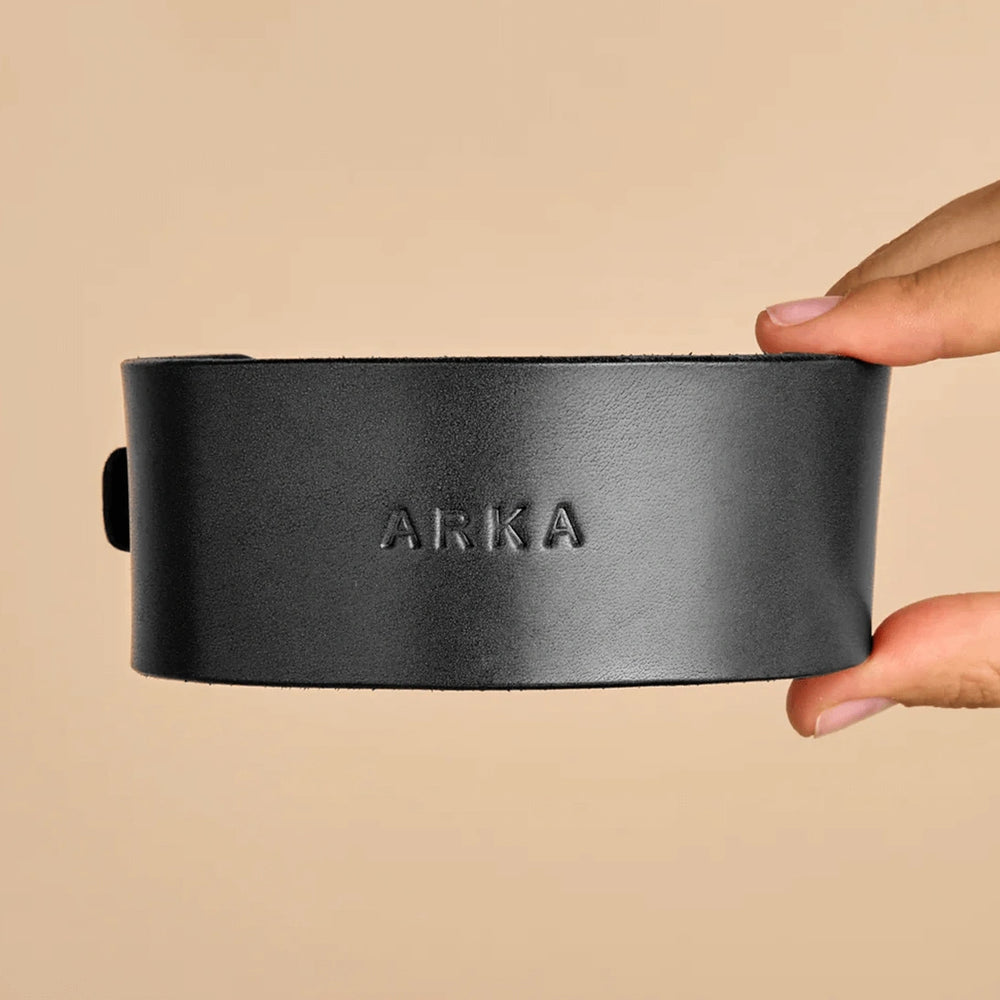
For most bulldogs and flat-faced breeds, the best everyday collar is a wider, full-grain vegetable-tanned leather collar with solid brass hardware. A broader band helps spread pressure across a thick, muscular neck, chromium-free leather sits gently against wrinkled, sensitive skin, and a snug flat-buckle fit helps resist the slipping these broad-headed breeds are prone to.
This guide shows why flat-faced anatomy changes the rules, and when a collar beats a harness. It also breaks down the three material pillars that separate a collar built for years from one that cracks in months. Every recommendation matches the construction of our own handmade full-grain leather dog collars.

Why Flat-Faced Breeds Need a Different Collar
Flat-faced breeds are built differently from the neck up. That anatomy drives every collar decision. A bulldog's neck is short, deep, and heavily muscled, often measuring close to the circumference of the skull itself. The head is not much wider than the neck, so a collar sized only for comfort can slide straight over the ears during a lunge or a backward pull. This is the most common failure owners report, and it is a fit-and-width problem, not a buckle problem.
The second factor is the brachycephalic airway. Short-faced breeds already work harder to move air. The French Bulldog's flat-faced, brachycephalic build pushes air through narrowed nostrils and a compressed windpipe. A thin collar concentrates force on a small band of the throat, which is the last place you want pressure on a dog already prone to labored breathing. A broader collar spreads that same force across a larger surface.
The third factor is skin. Bulldogs and Frenchies carry folds and shorter coats, so the collar sits in closer, warmer, more humid contact than it would on a long-coated breed. That makes material choice a health decision, not just a style one. A breathable, single-piece leather collar is less likely to trap moisture and odour against the skin than many synthetics or low-grade leathers. This is why material matters so much for these breeds.
The takeaway: a flat-faced breed benefits from a broader band for pressure distribution, a secure fit to defeat the head-to-neck slip, and a skin-friendly material for constant fold contact. A basic nylon collar can cover the first two, a wider cut and a snug buckle are not hard to find, but the skin-contact piece is where it most often falls short against the neck. For how width maps to breed, see our guide on choosing the right collar width for your dog's breed.
Collar or Harness for a Bulldog or Flat-Faced Breed
The collar-versus-harness question is where most bulldog guides go vague. Here is a clear rule. Use a collar for identification and calm, controlled lead work. Add a harness for active pulling or long walks. Both belong in a flat-faced dog's kit. They solve different problems.
A well-fitted collar is the right daily default. It carries the ID tag, suits dogs that walk politely, and keeps that tag visible and readable. That matters, because a harness often comes off at home while a collar stays on. The key qualifier is proportion. A thin, narrow collar on a brachycephalic breed concentrates load on a compromised airway. So if a collar is the main walking tool, choose one with a slightly broader band rather than a thin strap, without jumping to a heavy, maximal-width design that overwhelms a short neck. This is the same logic we cover in our breakdown of whether a collar can affect the trachea versus a harness.
A harness earns its place the moment a flat-faced dog pulls. Bulldogs are deceptively strong for their size, and a hard pull against any collar transfers force to the neck. A harness moves that force to the chest and shoulders, off the airway. For committed pullers, use a harness for walking plus a collar for ID. That is the safest combination. Our full-grain leather dog harnesses are built for exactly this pairing.
What you should not do is rely on a thin collar as a pulling brake for a brachycephalic dog. That setup is the most likely to aggravate breathing. Choose a wider collar for gentle control. Reach for a harness when pulling enters the picture. Keep the ID collar on either way.
The Three Pillars of a Bulldog Collar That Lasts
Once fit and proportion are handled, quality comes down to three things: leather grade, tanning method, and hardware. These are easy details to overlook, because a well-made collar and a cheap one can look almost identical in a photo. The difference usually only shows up after a season of daily use. Here is how the three pillars compare against the nylon and low-grade leather most bulldog collars use.
| Factor | Full-Grain Vegetable-Tanned Leather | Nylon or "Genuine" Leather |
|---|---|---|
| Pressure distribution | Firm full-grain body holds a broad, supportive shape and spreads load across a thick neck | Soft webbing bunches and narrows under tension, concentrating force |
| Skin-fold contact | Breathable and less likely to trap moisture and odour against sensitive skin | Synthetics can hold heat and moisture; chrome-tanned leather may irritate some dogs |
| Hardware | Solid brass buckle and welded D-ring that resist rust and corrosion | Plated steel or plastic that can rust, bend, or crack at the weak point |
| Longevity | Designed to last for years and soften into a patina with use | More prone to fraying, cracking, and peeling, often replaced yearly |
| Drool and cleaning | Edge-finished full-grain wipes clean and resists moisture absorption | Raw split leather can soak up drool; woven nylon holds odour |
Leather Grade: Full-Grain vs "Genuine"
Leather grade is the first thing that separates a lasting collar from a disposable one. It is also the detail marketing hides. Full-grain leather is the top layer of the hide, with the strongest and tightest fibre structure. That density lets a full-grain collar hold a broad, supportive shape against a bulldog's pull, without stretching out or curling at the edges.
The word to watch is "genuine." Genuine leather is usually a lower tier. It is a split or corrected grain, heavily finished to look premium in photos while being far less durable than full-grain. Many mass-market bulldog collars use it because it is fast and cheap to produce. It also photographs beautifully. Under daily use from a strong, stocky breed, that same material is more prone to cracking, peeling, and surface breakdown. Full-grain is one of the few collar materials that genuinely improves with time. It softens and conforms to the dog's neck, and it develops a rich patina rather than falling apart. Our full breakdown lives in our full-grain leather dog collar guide.
Tanning Method: Vegetable-Tanned and Chromium-Free
Tanning is the pillar almost no bulldog collar guide mentions. For flat-faced breeds with skin folds, it may be the most important one. Tanning is the process that turns raw hide into stable leather. There are two dominant routes. Chrome tanning uses chromium compounds, typically chromium(III). It is the fast, cheap method behind most mass-market and "genuine" leather. Vegetable tanning uses plant tannins instead. It takes far longer and produces a chromium-free leather.
For a breed in constant, warm, folded-skin contact with its collar, chromium-free matters. Chromium-tanned leathers and finishes can cause irritation for some dogs, and that risk rises with prolonged contact, heat, and moisture, which is exactly the environment a bulldog's neck creates. There are also well-documented regulatory concerns around leather chemistry. Under poor process control, some chromium(III) can convert into chromium(VI). Regulators classify chromium(VI) as carcinogenic, so they impose strict limits on it in leather that touches skin. We avoid chromium-based tanning entirely as a precaution. We choose vegetable-tanned, chromium-free leather instead. If you want to minimise your dog's exposure to heavy-metal tanning chemicals, chromium-free vegetable-tanned full-grain leather is the smarter long-term bet. It is also often better tolerated by many dogs with sensitive skin. We go deeper in our article on why some leather collars cause skin reactions.
Hardware: Solid Brass at the D-Ring
Hardware is where a bulldog collar is most likely to fail. The stocky, muscular pull of these breeds loads the buckle and the D-ring hard. Solid brass hardware is highly corrosion-resistant, and it does not rust like cheap plated steel or low-grade alloys. It holds its strength at the D-ring junction and buckle under normal dog-collar use. That is exactly where a leash clip yanks during a lunge.
Cheap collars economise here first. Plated steel looks like brass until the plating wears, and then the base metal underneath begins to rust. Plastic quick-release buckles can crack under sudden load from a heavy dog. A welded, solid brass D-ring removes the two most common weak points at once. It resists rust and corrosion, and it holds its shape where it matters most, the D-ring junction. This is built for years of daily use, not months. For the full argument, see our guide on why solid brass hardware is best for dog collars and leashes.
Best Collar by Flat-Faced Breed
Flat-faced breeds are not one size. An English Bulldog and a Pug share the same short-faced airway. Yet they sit at opposite ends of the neck-size range. So the right collar width changes with the dog. The table below maps typical neck ranges to a recommended width and the Lille Björn style that fits each build. Treat the neck ranges as starting points. Always measure your own dog, using our step-by-step method for how to measure your dog's neck for the perfect fit.
| Breed | Typical Neck Range | Recommended Width | Best Lille Bjorn Style |
|---|---|---|---|
| English Bulldog | 16 to 22 in (40 to 56 cm) | Wider, 3 cm | Aeris Classic or Vero Classic |
| French Bulldog | 11 to 16 in (28 to 40 cm) | Classic, 2.5 to 3 cm | Vero Classic or Aeris Classic |
| Pug | 10 to 14 in (25 to 36 cm) | Classic, 2 to 2.5 cm | Vero Classic |
| Boston Terrier | 12 to 16 in (30 to 40 cm) | Classic, 2.5 cm | Aeris Classic or Vero Classic |
| Boxer | 16 to 22 in (40 to 56 cm) | Wider, 3 cm - 4.5 cm | Aeris Classic or Aeris Wide |
English Bulldog
The English Bulldog is the archetype of the thick-necked, broad-headed challenge. The breed standard describes a thick-set, well-muscled Bulldog build, and that muscle sits right where the collar rides. The neck often measures 16 to 22 inches. The head is barely wider. So his breed benefits from a broader-than-average band more than almost any other. The width does two jobs at once. It spreads leash pressure across the muscular neck to reduce load on the airway. It also sits with enough contact to resist sliding forward over the skull. A narrow strap on an English Bulldog invites both a pressure point and an escape. A broader full-grain collar with solid brass hardware is a strong daily choice. Pair it with a harness for any serious pulling.
French Bulldog
The French Bulldog has the same brachycephalic airway as its English cousin. It has a much smaller frame, with necks usually in the 11 to 16 inch range. Here the goal shifts from maximum width to balanced width. A classic 2.5 to 3 cm full-grain collar gives a Frenchie enough surface to distribute pressure. It does this without overwhelming a compact neck, and the lighter weight suits the breed. Frenchies are strong for their build and quick to lunge at distractions. So fit precision matters as much as width. A personalized embossed collar also keeps ID details on the dog at all times. That is useful for a breed that is a frequent target for theft.

Pug
Pugs sit at the smallest end of the flat-faced group. Necks often fall between 10 and 14 inches. Yet they carry the same short-faced airway and the same tendency toward sensitive skin in their facial folds. A lightweight classic collar around 2 to 2.5 cm wide is the sweet spot. It is broad enough to keep pressure off a small windpipe, and light enough not to burden the dog. Vegetable-tanned, chromium-free leather is especially worth it for a Pug. The collar sits in close contact with a short coat and skin that is quick to react. Soft, breathable full-grain that softens with use is far kinder to that skin than stiff synthetic webbing.
Boston Terrier
The Boston Terrier is leaner and more athletic than a Bulldog. It still shares the brachycephalic face, so airway-friendly pressure distribution applies. Necks typically fall between 12 and 16 inches. A classic 2.5 cm full-grain collar suits the breed's trim, energetic build. Bostons are lively and can pull in bursts. So a secure buckle fit and a welded brass D-ring are worth prioritising. The breed's smart, tuxedo look also pairs naturally with a clean leather collar in a rich, natural tone.
Boxer
The Boxer is the largest and most powerful of the common flat-faced breeds. It has a deep chest, a strong neck of 16 to 22 inches, and real pulling force. This breed benefits from the same broader band as the English Bulldog. It also needs extra attention to hardware strength, because a Boxer can generate serious load on the D-ring. Full-grain leather holds its shape under tension. Combined with a solid brass welded ring, it gives a Boxer owner control without a thin strap digging into the throat. For committed pulling, a harness remains the walking tool of choice.
Getting the Fit Right and Stopping Escape
A great collar still fails on a flat-faced breed if the fit is wrong. Fit is also where the notorious bulldog escape gets solved. The head is barely wider than the neck. So a collar that is even slightly loose can be reversed straight over the ears. The fix is a precise, snug fit combined with adequate width. It is not a tighter thin strap.
Use the two-finger rule as your standard. You should be able to slide two fingers flat between the collar and the neck, and no more. Any looser, and a broad-headed breed can back out during a sudden stop. Any tighter, and you risk pressing on an already-compromised airway. Measure the neck at the widest point, low and close to the shoulders, where a bulldog's neck is thickest rather than high near the jaw. A broader collar helps here too, since a wider band is physically harder to drag over the skull than a thin one at the same tension.
Adjustability is the other half of the equation. A collar with several fitting holes lets you dial in the exact snugness that stops escape, without over-tightening. It also handles small seasonal changes in coat and weight. For growing puppies of these breeds, that adjustability is essential. If your dog still slips a correctly fitted wider collar, that is your signal. Move to a harness for walks and keep the collar for ID only. For the precise numbers by breed, our collar size guide for Frenchies and mid-sized breeds gives you the measurements to work from.

Drool, Skin Folds, and Long-Term Care
Flat-faced breeds bring two maintenance realities most collar guides ignore: drool and folded skin. Both are solvable. Both are reasons full-grain vegetable-tanned leather outperforms the alternatives over a collar's lifetime.
The common objection to leather for a drooly breed is that it soaks up moisture. That is true of raw, unfinished, or split leather. It is not true of edge-finished full-grain. A properly sealed full-grain collar wipes clean with a damp cloth, and it resists moisture absorption at the surface, so drool sits on top rather than soaking in. Woven nylon does the opposite. It holds moisture and odour deep in the weave. That is why nylon collars on Bulldogs and Boxers often develop a persistent smell. Single-piece leather construction has no fabric core to saturate. It is the more hygienic choice for a heavy drooler's neck.
Skin folds make breathability the priority. A collar on a Bulldog or Frenchie sits against warm, humid skin, so a material that lets air move and does not trap moisture reduces the risk of irritation under the band. Vegetable-tanned, chromium-free leather is breathable and less likely to trap moisture and odour than many synthetics. That makes it a better choice for many dogs with sensitive skin. Care is simple. Wipe after messy walks, let it dry naturally away from direct heat, and condition occasionally. Treated this way, a well-made full-grain, vegetable-tanned collar with brass hardware can realistically last for years. It often outlasts multiple cheap synthetic or low-grade leather collars. It is made to be the last collar you want to buy, not the next one you have to replace. Owners who want their dog's name embossed into the band can read our complete guide to personalized leather dog collars.
Frequently Asked Questions
Are collars or harnesses better for French Bulldogs?
Both, for different jobs. A wider, well-fitted collar is fine for carrying ID and for calm, controlled lead work. A harness is the safer choice for active walks or any Frenchie that pulls. French Bulldogs are brachycephalic, so avoid using a thin collar as a pulling brake. Keep a collar on for identification and reach for a harness when pulling is involved.
What size collar does an English Bulldog need?
Most adult English Bulldogs measure between 16 and 22 inches (40 to 56 cm) around the neck. Always measure your own dog at the widest point, low near the shoulders. Aim for a snug two-finger fit and choose a broader band to spread pressure and resist slipping over the head. Adjustable fitting holes let you fine-tune the fit as the coat and weight change through the year.
Why do bulldogs slip out of their collars?
A bulldog's head is barely wider than its neck. So a collar that is even slightly loose can be pulled backward over the ears during a lunge or a sudden stop. The fix is a snug two-finger fit paired with a wider collar, which is physically harder to drag over the skull than a narrow strap. If a correctly fitted wide collar still slips, switch to a harness for walks and keep the collar for ID.
Is leather or nylon better for a bulldog with sensitive skin?
Full-grain vegetable-tanned leather is generally the better choice for flat-faced breeds with sensitive or folded skin. It is breathable and less likely to trap moisture and odour against the skin than many synthetics. Being chromium-free, it is often better tolerated by many dogs with sensitive skin than chrome-tanned alternatives. Nylon can hold heat and moisture in the weave, which sits poorly against a bulldog's close skin contact.
Do broader collars really help brachycephalic breeds breathe easier?
A broader collar does not treat any airway condition. It does distribute leash pressure across a larger area of the neck, rather than concentrating it on a narrow band near the windpipe. For a short-faced breed that already moves air through a compressed airway, lowering that localized pressure is sensible. For dogs that pull hard or show breathing strain, pair the wide collar with a harness so walking force moves to the chest.
How long should a good bulldog collar last?
A well-made full-grain, vegetable-tanned leather collar with solid brass hardware is designed to last for years with proper care. It often outlives several cheap synthetic or low-grade leather collars. Longevity depends on use, cleaning, and the dog's growth, so it is built to outlive the average collar rather than guaranteed forever. Simple care, wiping it clean and letting it dry naturally, keeps it strong and looking better with age.