Quick Summary
Full-grain leather retains the hide's outermost fiber layer intact, giving it the strength, breathability, and longevity that make it the preferred material for dog collars. Vegetable-tanned full-grain leather with solid brass hardware is the definitive choice for owners who want a collar that softens with use, develops a rich patina over years, and stays in chromium-free contact with their dog's skin day after day.
Most leather dog collars look similar in a product photo. The differences that define how long a collar lasts, how it feels against your dog’s neck, and what chemicals are in contact with their skin every day are invisible until you know what to look for. Leather grade, tanning method, and hardware quality are the three variables that separate a collar built for a dog’s lifetime from one that starts cracking within two seasons. This guide covers each in precise detail so you can make a purchase built to last for years, not seasons.
What Full-Grain Leather Actually Means
Leather is not a single material. It is a spectrum of products ranging from premium hides with intact structural fiber networks to compressed scraps held together with adhesive, and the industry uses terms that make cheap materials sound equivalent to premium ones. Understanding the four grades is one of the most useful things a dog collar buyer can know before making a purchase.
The Four Leather Grades Ranked
| Grade | What It Is | Performance | Verdict for Dog Collars |
|---|---|---|---|
| Full-Grain | Outermost hide layer, intact fiber network, natural surface markings preserved | Dense, intact fiber structure; develops patina; lasts 5-10 years with care | The correct choice. Buy this. |
| Top-Grain | Outermost layer sanded and refinished with synthetic coating to remove surface imperfections | More uniform appearance, weaker fiber structure, cannot develop genuine patina | Acceptable but a clear step down. Will not age the same way. |
| Genuine Leather | Split hide layers from deep inside the hide, heavily coated to look premium in photos | Weak and brittle. Cracks and peels within 12-24 months of regular use. Coating flakes. | A weak choice for a collar. The name is misleading: it sounds premium but sits below top-grain in actual quality. |
| Bonded Leather | Leather dust and scraps compressed with polyurethane binder, like particleboard for leather | Delaminates under repeated tension. Often fails within one season of outdoor use. | Not recommended for a collar. The weakest of the four grades, prone to delaminating under everyday tension. |
One thing worth understanding about the grading system above is that "genuine leather" is not a compliment. Despite sounding like an authenticity marker, genuine leather is an industry term for a low tier of hide, sitting just above bonded leather, the weakest of the four grades. It is made from split layers cut from deep inside the hide where the fiber network is loose and fragmented, then heavily coated with dyes and synthetic finishes to simulate the look of full-grain in photographs. At the $10 to $25 price point, genuine leather or bonded leather is far more common than full-grain. The price point makes this likely: full-grain leather from a premium tannery costs significantly more per hide, and that cost is generally reflected in the final product price.
Why the Grain Layer Is the Structural Core of Every Hide
A cowhide is not a uniform sheet of material. From the outside inward, it moves through distinct zones with dramatically different fiber architectures. The grain layer, the outermost 0.5 to 1 millimeter of the hide, contains the tightest, most densely interlocked collagen fiber network in the entire skin. This is the layer that evolved to protect the animal from the outside world, and it is the layer that makes full-grain leather genuinely exceptional as a structural material.
When a collar is cut from full-grain leather, the grain surface is the outer face of the collar band. That intact fiber network is what gives full-grain its resistance to stretching and tearing under load, and its ability to flex repeatedly without cracking. It is also the surface that responds to oils from your dog’s coat, atmospheric humidity, and the natural conditioning of regular use to develop the deepening color and compression that characterizes a true leather patina. Remove that layer through sanding and synthetic refinishing as happens in top-grain production, and you lose both the structural advantage and the aging behavior. The collar becomes a reasonable material, but it is not the same thing.

Vegetable Tanning vs Chrome Tanning: The Process That Defines the Collar
Leather grade tells you which part of the hide was used. Tanning method tells you what chemicals were used to transform that raw hide into a stable, wearable material. For a dog collar, which sits against your dog’s skin for the majority of every waking day, the tanning method is not a minor technical footnote. It determines the chemical environment that is in constant contact with your dog’s neck.
How Vegetable Tanning Works
Vegetable tanning is the oldest tanning method still in commercial production, and it remains the most chemically simple. Hides are immersed in progressively stronger baths of plant-based tannins, natural polyphenol compounds extracted from sources including chestnut wood, quebracho bark, mimosa, and oak galls. The tannins bind chemically with the collagen proteins in the hide, stabilizing the fiber network and converting raw skin into leather without the use of synthetic chemicals, heavy metals, or petroleum-derived compounds.
The process takes weeks rather than hours, which is why vegetable-tanned leather costs more. A single hide moving through a traditional pit-tanning system will spend 30 to 40 days moving through increasingly concentrated tannin baths. The result is a leather with a firm hand, exceptional structural integrity, and a completely plant-derived chemistry in contact with whatever surface it touches.
For the dog wearing the collar, this translates directly into a material that is breathable, less likely to trap moisture and warmth against the neck, and free of the chromium compounds that define the alternative. Vegetable-tanned full-grain leather is also one of the few collar materials that genuinely improves with time, softening and conforming to the curve of your dog’s neck as the fiber network responds to use, body heat, and the natural oils transferred from coat to leather during daily wear.
Chrome Tanning and the Chromium Question
Chrome tanning was developed in the mid-1800s and now accounts for around 80-90% of all leather produced globally. The process uses chromium(III) sulfate salts to achieve in hours what vegetable tanning requires weeks to accomplish. The resulting leather is softer, more uniform, and more resistant to moisture than vegetable-tanned leather fresh off the production line. For mass-market goods where speed and cost define the supply chain, the advantages are decisive. For a collar worn against a dog’s skin around the clock, there are considerations worth understanding before making a purchasing decision.
The core concern is not chromium(III) itself, which is a naturally occurring mineral found in food and considered safe at normal exposure levels. The concern is that chromium(III) in finished leather can, under specific conditions including heat, moisture, and prolonged contact, undergo partial oxidation to chromium(VI). Unlike chromium(III), chromium(VI) is classified as a carcinogen and contact sensitizer by regulatory bodies including the EU’s REACH regulation, which sets a strict limit of 3mg/kg for chromium(VI) in leather that comes into contact with skin. Products exceeding that threshold can be recalled or banned from sale in regulated markets. The Leather Working Group (LWG) certification program was established in part to audit tanneries for compliance with chromium(VI) limits alongside broader environmental standards.
To be precise about the framing this deserves: the regulatory concern is not that all chrome-tanned dog collars are immediately dangerous, and claiming that would not be accurate. The concern is that the conversion pathway exists, that it is more likely under the warm, moist conditions that characterize prolonged skin contact, and that the precautionary approach available to dog owners who want to eliminate that exposure pathway entirely is to choose a collar tanned without chromium compounds from the start. That is what vegetable-tanned, chromium-free leather provides.
What This Means for Your Dog’s Skin
Most dogs wear their collar for the majority of every day, including during exercise when body temperature rises and moisture accumulates at the neck. For dogs with sensitive skin, a history of contact dermatitis, or breeds known for skin reactivity including many Bulldogs, West Highland White Terriers, and Golden Retrievers, the chemistry of the collar material is a practical concern rather than a theoretical one. Chromium-free, plant-tanned full-grain leather is breathable in a way that synthetic collars and heavily coated genuine leather are not, making it less likely to trap warmth and moisture against the skin and less likely to create the environment in which contact reactions develop. It is not a medical guarantee, and no collar can promise zero irritation for every dog. But as a precautionary choice for a material worn this frequently, chromium-free vegetable-tanned full-grain leather is the smarter long-term bet for many dogs, particularly those with any history of skin sensitivity.

How Full-Grain Leather Ages: The Patina Advantage
One of the most frequently repeated claims in leather goods marketing is that full-grain leather gets better with age. This is true, but it is worth explaining precisely what happens so you can evaluate the claim rather than simply accept it.
Why Only Full-Grain Develops a True Patina
Patina in full-grain vegetable-tanned leather is the result of several overlapping physical and chemical processes that occur at and just below the intact grain surface. Natural oils transferred from your dog’s coat and skin penetrate the outermost fiber layer and condition the collagen network from within, increasing suppleness while the surface itself undergoes gradual oxidation from UV exposure and air contact. The tannins in vegetable-tanned leather react with these oils and with atmospheric oxygen over time, darkening and deepening in a way that reflects the individual history of the collar, which walks your dog took, which seasons it wore, how the sun caught the buckle.
Real Patina, Documented Over A Year
The Vero Wide collar shown below documents this process directly. Worn for over a year, the leather has darkened and developed visible character at the points that see the most contact and flex with regular wear. The collar shows no cracking, flaking, or surface damage from ordinary use.


The Lille Björn VERO and AERIS Wide collar: first day of wear (first) and after over a year (second). Darkening and surface character build with regular use.
Photos shared with permission by @lina.the.iggy.
Simultaneously, the pressure of the collar resting against the neck compresses the outermost grain fibers in a consistent pattern that increases surface hardness and resistance to abrasion precisely where it is needed most. The collar becomes more resistant to surface scratching over time, not less. This is the opposite of what happens with genuine leather, where the synthetic coating that provides initial surface protection begins flaking and delaminating within a year or two of regular use, exposing the fragile split-hide layer beneath.
Top-grain leather cannot develop this patina because the grain layer that would undergo these processes has been sanded away and replaced with a synthetic polyurethane or pigment finish. The finish can be waxed and polished, but it is not a living material interacting with use. It ages by degrading rather than improving.
The International Council of Tanners, the global trade body for leather producers, notes that leather retains its desirable properties of strength, flexibility, and breathability only when correctly handled and maintained, properties that are most fully expressed in full-grain construction.
The Break-In Period and What to Expect
A new full-grain vegetable-tanned leather collar will feel firm and have a slight stiffness to it. This is normal and is a direct expression of the dense fiber network and the tight tannin chemistry. Over the first two to four weeks of regular wear, the collar will begin to soften noticeably as body heat and movement work the fiber network and as the leather absorbs trace amounts of the natural oils present in your dog’s coat. By six to eight weeks, a well-made full-grain collar will have conformed to the curve of your dog’s neck sitting more comfortably and moving more naturally with every step.
This break-in process is not a defect or a sign of inferior quality. It is the behavior of a living material doing exactly what it is designed to do. A collar that feels perfectly soft the moment you remove it from the packaging is almost certainly a lower-grade leather with a heavy synthetic coating doing the softening work. Real full-grain vegetable-tanned leather earns its comfort through use.
Matching Leather Grade to Your Dog’s Size and Lifestyle
Full-grain leather is correct for dogs of every size and lifestyle, but the specific cut thickness and collar width that maximizes comfort and durability varies significantly depending on your dog’s build and how the collar is used. The following guidance applies to full-grain vegetable-tanned leather specifically.
Small and Toy Breeds
Small breeds including Chihuahuas, Toy Yorkshire Terriers, Maltese, and Miniature Dachshunds need a collar that is full-grain for durability and safety, but sized correctly to remain proportional against a delicate neck. Full-grain leather at our standard 2.8 to 3 millimeter thickness remains structurally correct even at small scale. What changes for small breeds is collar width, which should sit between 1 and 2 centimeters to stay proportional and lightweight against a small neck. The leather grade and thickness stay the same across every size; only the width is adjusted. Supple full-grain Italian leather softens through the natural break-in period, so a correctly sized small-breed collar will not cause rubbing on a small, thin-skinned neck.
For personalized collars on small breeds, full-grain leather holds hand-embossed or stamped personalization better than any other grade because the intact grain surface accepts the impression cleanly and the pattern deepens and darkens as the leather develops its patina, making the name more legible over time rather than less.
Medium Breeds
Medium breeds from 10 to 25 kilograms, including Beagles, Cocker Spaniels, Border Collies, and French Bulldogs, are well served by full-grain leather at our standard 2.8 to 3 millimeter thickness and a collar width of 2 to 3 centimeters. This range provides a collar with meaningful structural integrity during leash tension without the bulk of a large-breed cut. For active medium breeds that pull during walks, opting toward the upper end of this thickness range ensures the collar maintains its shape and does not stretch over years of use. A well-made full-grain collar in this dimension, paired with a matching leather leash, will typically outlast three or four nylon collars purchased at the same price point or below.
Large and Working Breeds
Large and working breeds from 25 kilograms upward, including Labrador Retrievers, German Shepherds, Rottweilers, and Weimaraners, generate significant leash tension and require a collar with both the width to distribute that pressure across the neck and the leather thickness to maintain structural integrity under repeated load. Full-grain leather at our standard 2.8 to 3 millimeter thickness, cut to a width of 3 to 4.5 centimeters, provides the correct combination.
At this thickness, full-grain vegetable-tanned leather with solid brass hardware can realistically last for many years of daily working use. The investment arithmetic is straightforward: a single premium full-grain collar purchased once is almost always less expensive over a working dog’s active life than the series of replacements that a mass-market collar requires.
Large breeds with short, smooth coats, such as Vizslás, Weimaraners, and Dobermanns, wear their collar directly against skin with no coat buffer underneath. At the 3.5 to 4.5 centimeter width recommended above, the collar distributes leash pressure across more surface area than a narrow collar would, reducing the concentrated force at any one point on the neck. The natural breathability of vegetable-tanned leather also helps reduce the buildup of warmth and moisture against bare skin, which can contribute to irritation over time, particularly compared to synthetic alternatives.
Sighthounds and Sensitive-Skin Dogs
Sighthound breeds including Greyhounds, Whippets, Salukis, and Italian Greyhounds present a specific combination of requirements: a long, slender, sensitive neck with very little natural padding between collar and skin, paired with a head narrower than the neck that creates an escape risk with any collar that is not wide enough to sit securely. For sighthounds, a wide full-grain leather collar cut to 4.5 centimeters or wider in the softest, most supple full-grain available is the correct choice regardless of body weight. The intact grain surface is smooth and non-abrasive against skin with minimal coat coverage, and a well-broken-in vegetable-tanned leather collar conforms to the unique curved anatomy of a sighthound neck in a way that rigid synthetic materials cannot.
For dogs with a documented history of contact skin reactions, chromium-free vegetable-tanned full-grain leather removes one of the most common leather-specific contact allergens from the equation. This does not guarantee zero reaction for every sensitive dog, but it eliminates the chromium chemistry that is responsible for a meaningful share of contact dermatitis cases associated with leather accessories. If you want to minimize your dog’s exposure to heavy-metal tanning chemicals while providing a collar that lasts and is genuinely comfortable against sensitive skin, chromium-free full-grain leather is the considered choice.

Why Hardware Grade Matters as Much as Leather Grade
A full-grain vegetable-tanned leather collar fitted with cheap plated steel hardware is a compromised product. The leather will outlast the hardware by years, and when the hardware corrodes, loosens, or fails at the D-ring junction, the collar becomes unsafe regardless of how beautiful the leather still looks. Hardware selection is not a cosmetic decision.
Solid Brass vs Plated Steel vs Zinc Alloy
Solid brass is the correct hardware specification for a premium leather dog collar and the one used across The Lille Björn’s full collar range. Brass is an alloy of copper and zinc that is inherently corrosion-resistant without any surface treatment: it does not rust in the way that steel does, and it maintains its structural integrity under the cyclical load of leash attachment and release over years of use. The patina that develops on solid brass hardware over time, a deepening golden tone with natural variation at stress points, complements the patina developing in the leather it is attached to, creating an aesthetic coherence that no plated metal can replicate because plating wears away.
Solid brass is the correct hardware specification for a premium leather dog collar and the one used across The Lille Björn's full collar range. Brass is an alloy of copper and zinc that is inherently corrosion-resistant without any surface treatment: it does not rust in the way that steel does, and it maintains its structural integrity under the cyclical load of leash attachment and release over years of use. The patina that develops on solid brass hardware over time, a deepening golden tone with natural variation at stress points, complements the patina developing in the leather it is attached to, creating an aesthetic coherence that no plated metal can replicate because plating wears away.
Brass Patina After More Than A Year
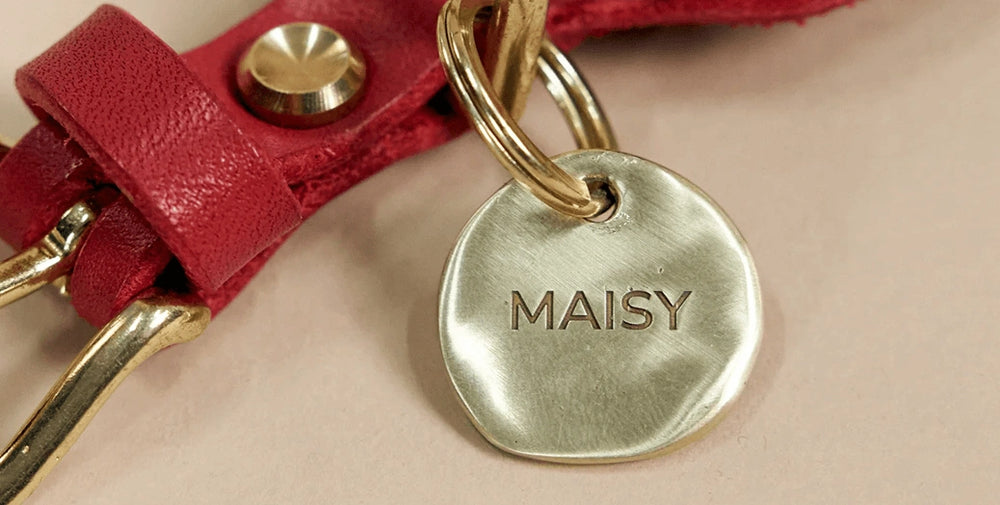
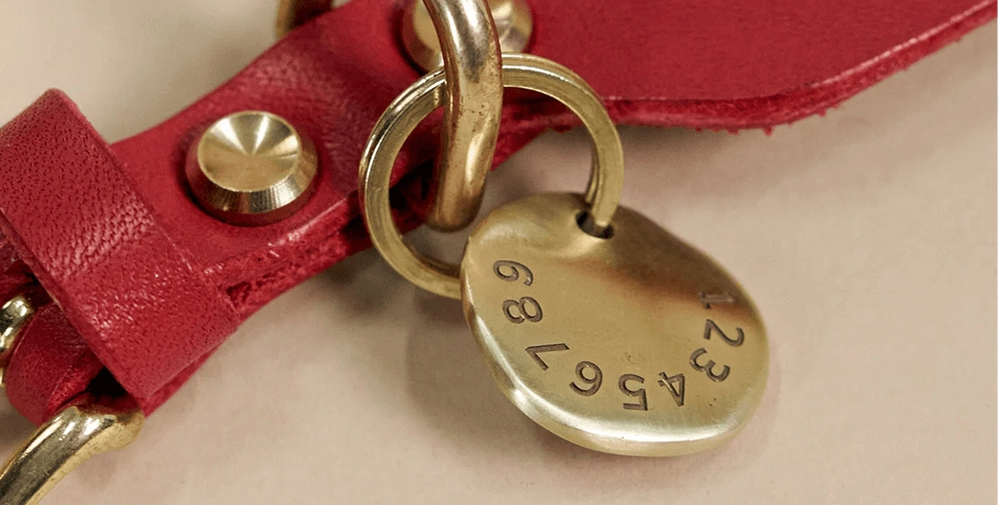
The nametag below has been worn for over a year. The brass has developed a deepened, mottled tone concentrated on the raised surface and edges, the parts that see the most handling and contact with the leather it hangs from. The engraved lettering stays fully legible throughout, since the engraving sits below the surface that ages.

A Pebble brass nametag after more than a year of wear. Darkening concentrates on the raised surface and edges; the engraved name stays legible.
Photos shared with permission by @lina.the.iggy.
Zinc alloy hardware, often labeled as “die-cast metal” or simply left unlabeled in product listings, is the most common alternative found in mid-range collars. It is significantly cheaper to produce and feels similar to solid brass when new. Under prolonged exposure to moisture, dog saliva, and the mechanical stress of daily use, zinc alloy hardware corrodes from within, developing white powdery surface oxidation and eventually failing at stress points. The failure mode is brittle fracture rather than the gradual deformation of brass, making it a safety concern for strong dogs or high-tension leash use.
Chrome-plated steel hardware presents a different problem. The plating itself introduces another source of chromium at the collar’s contact points, specifically at the buckle and D-ring where the metal sits closest to the neck. For owners specifically choosing vegetable-tanned leather to avoid chromium compounds, chrome-plated hardware would partially undermine that decision. Solid brass hardware at buckle and D-ring is the consistent, non-contradictory specification.
The D-Ring Stress Point
The D-ring is the single highest-stress point on any dog collar. Every leash attachment, every time a dog pulls against resistance, every reactive lunge, transmits its force through the D-ring and the leather surrounding it. On a well-constructed collar, this junction is reinforced with either saddle stitching at a high stitch density or with solid brass rivets, or both. The D-ring itself should be a welded ring, not a split ring or folded metal construction, which are more vulnerable to gradual opening under repeated lateral load. For a full breakdown of how buckles and D-rings are constructed and attached, see our dog collar hardware guide.
When inspecting a full-grain leather collar, the D-ring attachment point is the first place to look for evidence of quality. Loose stitching, thin thread, a folded rather than welded ring, or any visible gap between the ring and the leather are signals of a collar that can fail at the worst possible moment. A well-made solid brass welded D-ring set into correctly stitched full-grain leather should feel completely immovable when pulled by hand.
The Long-Term Value Case: Full-Grain vs Mass-Market Collars
Premium full-grain vegetable-tanned leather collars with solid brass hardware are priced at a level that often gives buyers pause when nylon alternatives exist at a fraction of the cost. The financial case for the premium option is clearest when evaluated over the realistic ownership timeline rather than the initial purchase price. For owners who want to extend that investment across a coordinated set, our leather walk kits pair a matching collar, leash, and harness from the same Italian hide lot.
| Collar Type | Typical Lifespan | Typical Cost | Est. Cost Per Year | Over 7 Years |
|---|---|---|---|---|
| Nylon collar | 6-18 months | $10-20 | $10-20 | $70-140 |
| Genuine leather collar | 12-24 months | $25-45 | $15-35 | $105-245 |
| Full-grain vegetable-tanned leather | 5-8 years with care | $69-85 | $8-17 | $69-85 (one collar) |
The arithmetic above is not a guaranteed prediction; actual lifespan depends on the individual dog’s activity level, care routine, and the specific quality of each collar within its category. But the pattern is consistent: a full-grain vegetable-tanned leather collar designed to last for years is typically the most cost-effective collar choice over the realistic ownership horizon of a medium or large breed dog. It is designed to outlast several cheaper collars, not to need replacing after one or two seasons.
What to Look for on a Full-Grain Leather Collar Before You Buy
The leather grade claims made in product descriptions and on packaging are not regulated in any meaningful way in most markets. A product can legally describe itself as a “premium leather collar” regardless of what grade of leather or what tanning method was used. The following signals allow you to evaluate quality independently of marketing language.
The Green Flags: Quality Signals
- Natural surface variation visible: Full-grain leather shows the natural grain pattern of the original hide, including minor scars, tick bites, and surface variation. A perfectly uniform surface with no variation is almost certainly a corrected-grain or synthetic coating.
- Firm hand with natural flexibility: Full-grain leather should feel substantial and slightly firm when new, bending cleanly without the stiffness of cardboard. It should not feel immediately soft and pliable like fabric or feel rubbery, both of which indicate heavy synthetic coating.
- Cut edges that are burnished or painted, not raw: Professionally finished full-grain leather collars have sealed edges, either burnished smooth through friction and moisture or finished with a vegetable-based edge paint. Raw, fuzzy cut edges indicate split-hide or bonded leather where the inner structure is exposed.
- Dense, consistent stitching with waxed thread: High-quality saddle stitching should be regular and tight with no loose threads, gaps, or uneven spacing. Waxed thread resists moisture and abrasion significantly better than standard polyester thread.
-
Hardware that feels solid and heavy: Solid brass has a weight and density that plated steel and zinc alloy do not. The buckle and D-ring should feel substantial, with the D-ring welded closed and completely immovable.
The Red Flags: Poor Quality Signals
- Strong chemical or plasticky smell: Fresh full-grain vegetable-tanned leather has a clean, slightly earthy, natural leather smell. A strong chemical odor indicates heavy synthetic finishing or solvent-based dyes. A plastic smell indicates bonded leather or PU-coated genuine leather.
- Perfect, uniform surface with no natural marking: As described above, real full-grain leather is not perfectly uniform. If it looks like it was printed, it was probably finished to conceal lower-grade leather beneath.
- Immediate softness out of packaging: A full-grain vegetable-tanned collar should feel firm and require breaking in. Immediate fabric-like softness is a sign of synthetic coating doing work the leather cannot.
- Light weight for the stated size: Full-grain leather at proper thickness has meaningful weight. An unexpectedly light collar at a stated large size is likely cut from thin genuine leather or bonded leather.
- Fuzzy or rough cut edges: Split-hide construction exposes the fibrous internal structure at cut edges, which cannot be cleanly burnished. If the edges look raw and slightly hairy, the collar is not full-grain.
Frequently Asked Questions
What is full-grain leather and why does it matter for dog collars?
Full-grain leather uses the outermost layer of the hide, where the collagen fiber network is tightest and most densely interlocked. It is the strongest, most breathable, and most durable grade of leather available. For dog collars, it matters because the collar sits against your dog’s skin for most of their waking day: a full-grain collar is less likely to crack, peel, or degrade under daily use, and it develops a patina over time that makes it more resistant to surface abrasion, not less. Lower grades like genuine leather or bonded leather may look similar in product photos but typically crack or delaminate within one to two years of regular outdoor use.
Is vegetable-tanned leather safer for dogs than chrome-tanned leather?
Vegetable-tanned leather is chromium-free, meaning none of the tanning chemistry involves chromium compounds. Chrome-tanned leather uses chromium(III) sulfate, and under conditions of heat, moisture, and prolonged skin contact, a portion of chromium(III) can convert to chromium(VI), a regulated carcinogen and contact sensitizer. The risk in a normal-use collar is not immediately severe for most dogs, but for owners who want to eliminate that chemical pathway from their dog’s daily skin contact environment entirely, vegetable-tanned leather is the straightforward choice. It is also more breathable and less likely to trap warmth and moisture against the neck, which reduces the risk of contact irritation for dogs with sensitive skin.
How long does a full-grain leather dog collar last?
A well-maintained full-grain vegetable-tanned leather collar with solid brass hardware can realistically last five to ten years of regular daily use for most dogs. The leather itself does not degrade the way that synthetic materials or lower-grade leather does: it develops character and hardens slightly at the surface over time, increasing durability rather than reducing it. The practical lifespan depends on the individual dog’s activity level, whether the collar is occasionally conditioned with a natural leather conditioner, and whether it is dried properly after heavy water exposure. In most cases, a premium full-grain collar outlives two to four nylon collars or three to five genuine leather collars purchased at lower price points.
What is the difference between full-grain and genuine leather in a dog collar?
Full-grain leather uses the outermost, structurally strongest layer of the hide with the natural grain surface intact. Genuine leather, despite its name suggesting authenticity, uses split layers cut from deep inside the hide where the fiber network is loose. It is heavily coated with synthetic dyes and finishes to simulate the appearance of full-grain in photographs. Genuine leather collars typically crack and peel within 12 to 24 months of daily outdoor use as the coating deteriorates and the fragile split hide beneath is exposed. The name “genuine leather” is a legal grade descriptor, not a quality endorsement.
How do I know if a leather dog collar is actually full-grain?
Full-grain leather shows natural surface variation including minor scars, grain irregularities, and tonal variation across the hide. It feels firm and substantial when new with a slight stiffness that softens over the break-in period. It has clean, burnished cut edges rather than fuzzy, fibrous ones. The smell is a clean, slightly earthy natural leather smell rather than a chemical or plasticky odor. Solid brass hardware feels noticeably heavier than zinc alloy. UNIC certification or identified Tuscan tannery provenance are reliable third-party signals. If a leather collar is priced under $20 to $25, it is almost certainly not full-grain regardless of what the description says.
Can a wide full-grain leather collar work for small dogs?
Width should be proportional to the dog’s neck size and build rather than simply maximized. For small dogs under 10 kilograms, a collar width of 1 to 2 centimeters is typically more comfortable than a wide cut, which would add unnecessary weight and bulk to a delicate neck. Full-grain leather at these dimensions remains the correct grade choice for small breeds: the quality difference between full-grain and genuine leather applies equally to a tiny Chihuahua collar as to a large-breed working collar, and the personalization and patina behavior of full-grain leather are no less desirable at a small scale. The Vero Classic collar is available in XXS sizing specifically to provide full-grain Italian leather quality at dimensions appropriate for the smallest breeds.
Does a full-grain leather collar need special care?
Full-grain vegetable-tanned leather requires minimal but specific care. For daily use, no maintenance is needed beyond normal wear. Every two to three months, or when the leather begins to look dry or slightly dusty in texture, apply a small amount of natural leather conditioner such as pure neatsfoot oil or a beeswax-based conditioner with a cloth, working it gently into the grain surface and allowing it to absorb fully before the collar is worn again. After heavy water exposure, allow the collar to dry naturally away from direct heat. Avoid leaving the collar in direct sunlight for extended periods when not being worn. With this minimal routine, a full-grain leather collar will remain supple and strong for the full duration of its intended lifespan.
What hardware should a high-quality leather dog collar have?
Solid brass is the correct specification for premium full-grain leather collar hardware. Solid brass is inherently corrosion-resistant without surface plating, pairs naturally with the aging behavior of vegetable-tanned leather, and maintains its structural integrity at the D-ring junction over years of leash attachment and tension. The D-ring should be welded closed, not split or folded, and the buckle should be a traditional pin buckle with reinforced rivets at the leather attachment points rather than a plastic quick-release mechanism. Zinc alloy hardware corrodes under prolonged moisture and mechanical stress and is a safety risk for strong or active dogs. Chrome-plated steel hardware introduces chromium at the collar’s closest contact points with the neck, which is counterproductive for owners choosing vegetable-tanned leather specifically to avoid chromium compounds.