Quick Summary
Dog collar hardware lasts longest when the buckle and D-ring are solid brass and fixed to the leather with a two-piece threaded fastener rather than stitching. Chicago screws, a post and screw that thread together through the leather, create a mechanical joint with no thread to fray, and unlike stitching, the joint isn't dependent on a single fiber holding under repeated stress. The Lille Björn secures every Chicago screw with thread-locking adhesive at assembly, so the connection is set once and stays set rather than needing to be checked or retightened over time.
Solid brass resists rust and corrosion because it contains no iron, the element that oxidizes into red rust on steel and iron-based hardware. Brass is an alloy of copper and zinc, so it does not rust under normal outdoor conditions, rain, sweat, or repeated washing. Combined with a Chicago screw attachment that has no thread to fray, this is what makes a collar's hardware, not just its leather, last for years of daily use.
Most buying guides stop at "look for solid brass," but the metal is only half the story. How that metal is fixed to the strap determines whether the collar survives years of daily pulling, or starts failing at the exact point where the leash clips on.
Walk into any pet store and you'll see collars built different ways. Most use stitching: thread looped through holes punched in webbing or leather, holding the buckle and D-ring folds together. A smaller number use Chicago screws, sometimes called binding posts: a two-piece fastener where a post and a screw thread together through both layers of material, tightened with a household screwdriver rather than a needle and thread. Each method has a different failure mode, and understanding that difference is the easiest way to judge whether a collar's hardware will actually hold up.

Dog Collar Hardware: Buckle, D-Ring, and How They're Attached
Every flat collar relies on three hardware components doing their job at the same time: a buckle to close the loop, a D-ring to take the leash clip and ID tag, and whatever fastening method joins both pieces to the leather strap. Each one fails differently if it's poorly made, and each one is worth understanding on its own before judging a collar as a whole.
The buckle is the part under constant low-level tension every time the collar is worn. A well-made buckle is sized to the strap width with no play at the pin, so it doesn't work itself loose through ordinary movement. Solid brass buckles resist the kind of corrosion that turns a smooth-closing buckle stiff and gritty after repeated exposure to rain, sweat, and saliva. Cheaper alternatives, particularly plated steel, often look identical on a shelf but corrode at the seams within a season of regular outdoor use.
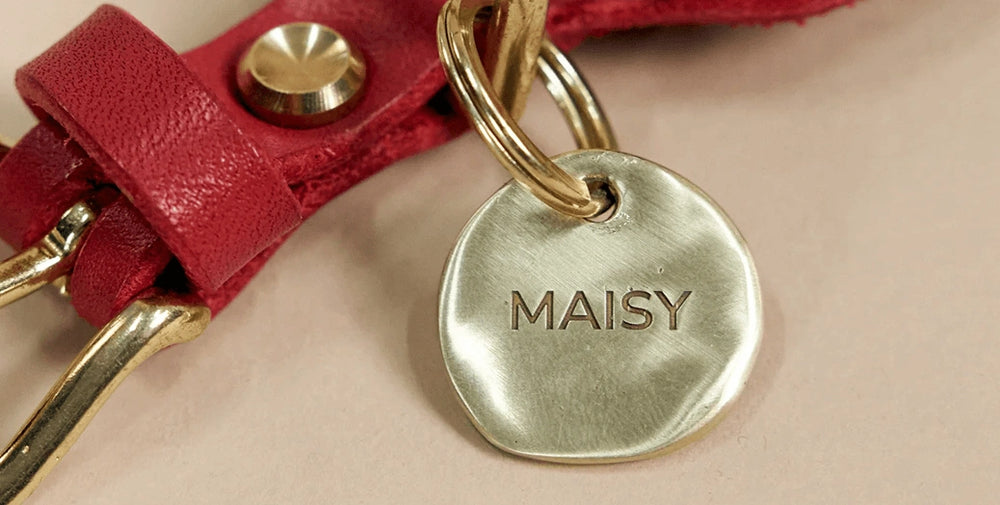
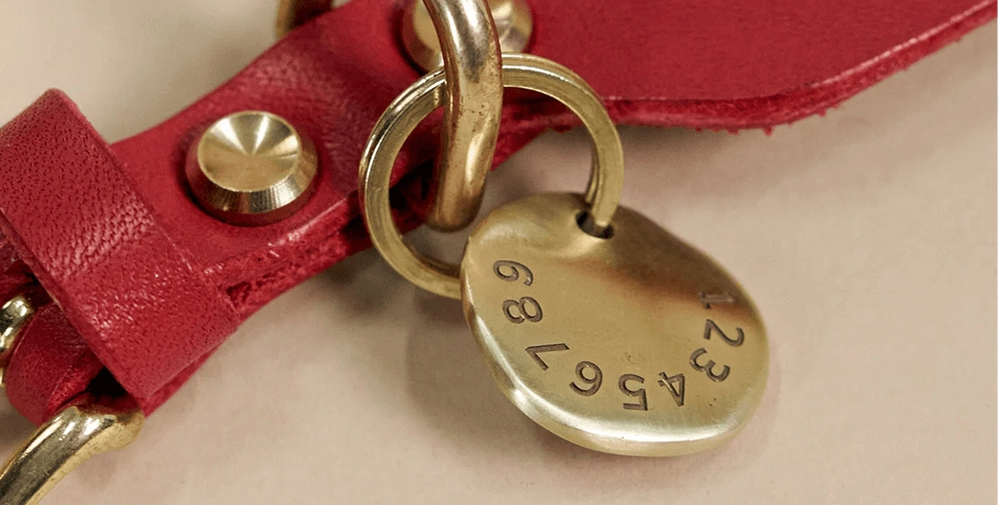
The D-ring takes a different kind of stress: sudden, sharp pulls rather than constant tension. Every time a dog lunges at a squirrel or hits the end of the leash, the full force of that motion travels through the D-ring before it reaches the strap. This is why D-ring placement and attachment method matter more than almost any other single design choice on a collar. A D-ring that's stitched into a loop of leather relies entirely on the thread holding under that shock load. A D-ring that's stitched into a loop of leather relies on the thread holding under that shock load, and a well-executed box stitch at this point can hold up reliably for years. A D-ring fixed with a Chicago screw relies on a threaded metal post and screw holding the leather firmly between them instead, a mechanical joint rather than a fiber one. On The Lille Björn's collars, that post and screw are set with thread-locking adhesive at assembly, so the joint is secured permanently rather than left to be checked or adjusted later.
That third component, the fastening method itself, is the part buying guides almost never explain, which is exactly why it deserves its own section.
Chicago Screws vs Stitched Dog Collar Construction: What Actually Holds Up
Stitching is the most common way hardware gets attached to webbing and leather collars, and for good reason: it's fast, cheap, and works fine for light use. A row of thread loops through punched holes, usually reinforced with a box stitch or an X pattern at the stress points. The weakness is structural, not a sign of poor craftsmanship: thread is the single point that all the tension has to pass through, and thread degrades. UV exposure, repeated wet-dry cycles, and the simple mechanical fatigue of being yanked thousands of times all work against a stitched seam in the same way. When a stitched collar does eventually fail, it's typically at the seam rather than in the leather or webbing itself, and a worn stitch generally needs re-sewing. That's simply the tradeoff of a fiber-based joint, not a defect: stitching remains a proven, widely used method that performs reliably for years under normal use.
A Chicago screw solves this differently. It's a two-piece fastener, a post and a screw, that thread together through both layers of leather at the point where the D-ring or buckle needs to be fixed. There's no needle, no thread, and nothing to fray. On its own, an unsecured Chicago screw is a removable, threadable fastener, which is part of what makes it a strong joint to begin with: the post and screw grip the leather directly rather than relying on a stitched loop. Hardware suppliers to the leather and saddlery trade have long described metal fastening methods, rivets and threaded posts alike, as a stronger connection point than stitching for straps, collars, and harnesses, precisely because the joint doesn't rely on a fiber that degrades under UV and moisture the way thread does.
The Lille Björn's collars are fastened with Chicago screws throughout. Every collar is cut from a single piece of full-grain Italian vegetable-tanned leather, and the solid brass buckle and D-ring are fixed through that leather with threaded Chicago screws. This isn't a cosmetic choice. It means there's no stitched seam anywhere on the collar that may fray, loosen, or degrade with age, which is the specific failure point that ends the working life of most stitched collars long before the leather itself gives out, and if a screw connection does ever need attention, it's serviceable rather than a dead end.
It's worth being precise about what this claim does and doesn't mean. Removing stitching as a failure point doesn't make a collar indestructible, no hardware claim should ever promise that, and a Chicago screw can still loosen under extreme or prolonged stress the same as any threaded fastener. What it does mean is that one entire category of wear and tear, the slow degradation of thread under UV and moisture, simply isn't a factor in how this collar ages, and the fastening method that replaces it is serviceable rather than a one-time, irreversible set. Because The Lille Björn's Chicago screws are thread-locked at assembly rather than left to rely on friction, the connection doesn't depend on staying tight over years of use, it's set once and stays set. That's a meaningful, verifiable difference, not a marketing exaggeration.

How to Judge Dog Collar Hardware Quality Before You Buy
Most shoppers judge collar hardware the way they judge a used car: by how it looks, not by what's underneath. A few minutes of close inspection tells you far more than a product photo ever will, and the checks are simple enough to do in a store or by zooming into listing photos online.
Start with the buckle. Press the tongue or pin gently to one side: it should move only enough to release, with no sideways wobble in the housing. Wobble at the pin means the buckle was either undersized for the strap or assembled with loose tolerances, and that looseness only gets worse with use, never better. Next, look at the metal finish itself. Solid brass has a consistent color all the way through, including in scratches and worn edges. Brass-plated steel, by contrast, reveals a different colored base metal the moment the plating wears through, usually within months of regular outdoor use.
Then check the D-ring attachment point, since this is where hardware fails. If the collar is stitched, look closely at the thread itself: is it a single thin line, or a reinforced box pattern with multiple passes? A single line of stitching at the D-ring is a clear sign of corner-cutting, since this is the single highest-stress point on the entire collar. If the collar uses Chicago screws instead, check that the screw head sits flush against the leather with no visible gap, and that it doesn't turn freely when nudged, a properly set screw should feel snug, not loose.
Finally, consider the leather itself, since hardware is only as good as what it's anchored into. Full-grain leather holds threaded hardware far more securely than the split, corrected-grain "genuine leather" common in budget collars, since the dense, unbroken fiber structure near the hide's surface resists compressing or tearing around the fastener in a way that lower-grade leather simply can't. Leather manufacturers describe split leather as lacking the grain layer's tight fiber structure entirely, making it considerably more prone to tearing under the same load that full-grain leather resists without damage. A Chicago screw through full-grain leather clamps against the strongest part of the hide. The same fastener through split leather is clamping against a weaker, more fibrous layer that's more prone to compressing and loosening around the screw over years of tension.
| What to Check | Sign of Quality | Warning Sign |
|---|---|---|
| Buckle pin | No sideways wobble in the housing | Loose movement beyond the release action |
| Metal finish | Consistent color through scratches (solid brass) | Different base metal visible under wear (plated) |
| D-ring attachment, stitched | Reinforced box stitch, multiple passes | Single thin line of thread |
| D-ring attachment, riveted or screwed | Flush, snug fastener with no play when nudged | Visible gap or a screw that turns freely |
| Leather grade | Full-grain, dense fiber structure | Split or corrected-grain "genuine leather" |
Why Hardware Attachment Matters More for Active and Strong Dogs
A collar's hardware gets tested differently depending on the dog wearing it. A small, calm dog that walks politely on leash puts a fraction of the stress on a D-ring compared to a large, athletic dog that lunges at every passing squirrel, and the attachment method that's perfectly adequate for one can be genuinely inadequate for the other.
Sudden, sharp tension, the kind generated when a 30-kilogram dog hits the end of a leash at a dead run, concentrates enormous force into a very small area at the D-ring junction for a fraction of a second. This is a fundamentally different stress than the slow, steady pull of a dog leaning into a harness or walking calmly on a loose lead. A stitched D-ring loop has to absorb that shock entirely through the thread and the small patch of material it's sewn into, with no way to fix it once a stitch starts to go. A stitched D-ring loop absorbs that shock through the thread and the small patch of material it's sewn into. A D-ring fixed with a Chicago screw transfers that same shock through a threaded metal post and screw clamped through the leather instead, a mechanical joint rather than a fiber one. On The Lille Björn's collars, that joint is thread-locked at assembly, so it's built to hold under repeated shock loading rather than depending on periodic maintenance.
This is also where breed and activity level become genuinely relevant to a hardware decision, not just a sizing one. Dogs with high prey drive, strong recall issues, or simply more raw pulling strength put repeated, unpredictable shock loads through exactly the part of the collar that stitching is weakest at. For these dogs, threaded hardware has a real advantage over stitching: the joint doesn't depend on a single fiber holding under repeated shock loading. That's a meaningful factor for high-drive or high-strength dogs specifically, not a reason to rule out stitching for every dog.
None of this means a stitched collar is unsafe for every dog. A correctly sized, well-stitched collar on a calm, smaller dog can perform reliably for years. But the margin for error shrinks considerably as a dog's strength and unpredictability increase, and that's precisely the scenario where removing thread from the equation entirely, the way Chicago-screw construction does, stops being a preference and starts being a meaningful safety margin, one piece of the broader case for why leather collars tend to outlast synthetic alternatives in daily use.

The Lille Björn's Approach to Hardware Construction
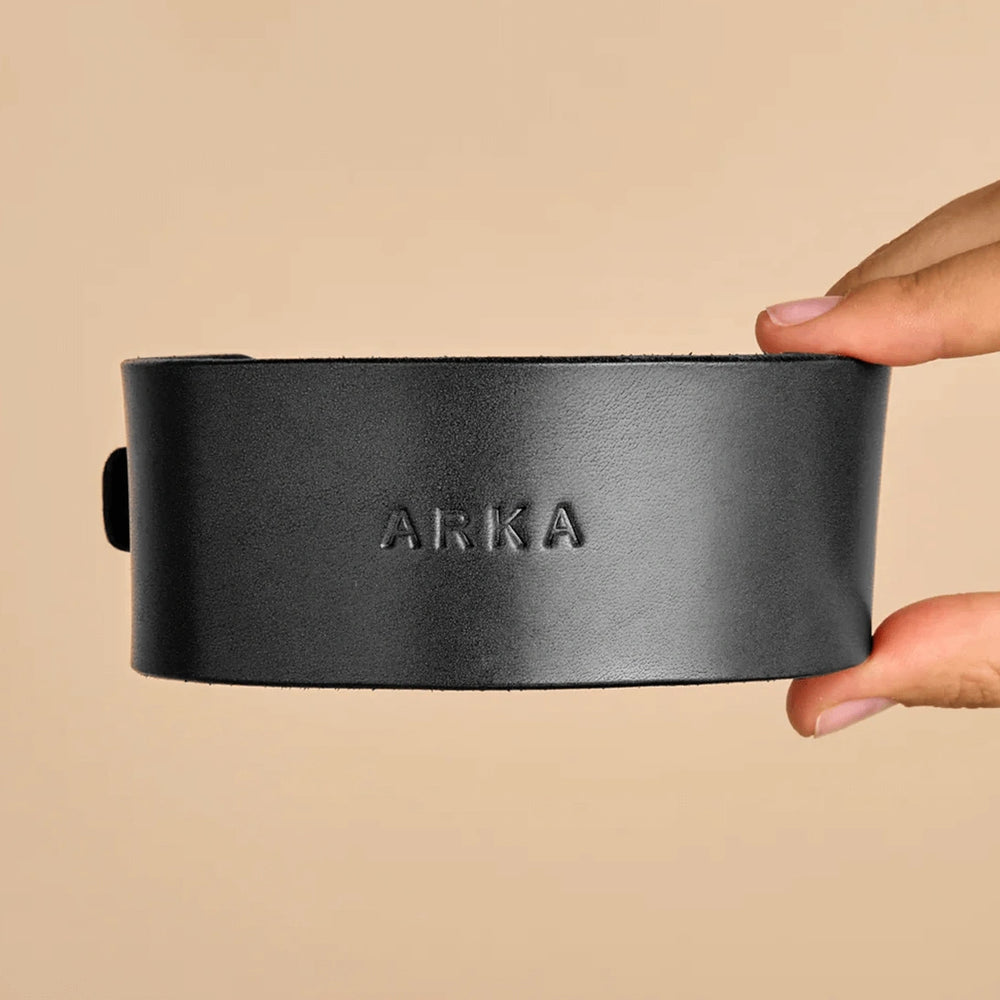
Every Aeris and Vero collar is cut from a single piece of full-grain Italian vegetable-tanned leather, with solid brass hardware fixed through that leather using Chicago screws rather than stitching anywhere in the construction. The Aeris Classic and both Wide collars come in a fixed width, 3cm for Classic and 4.5cm for Wide, while the Vero Classic offers a genuine width choice between 2cm and 3cm for owners who want a narrower fit for a smaller or more sensitive-necked dog without stepping up to the Wide line. Browse the full leather dog collar collection to compare widths and colors side by side.
This construction approach was a deliberate choice, not a default. Stitching is faster and cheaper to produce at scale, which is why most collars, including many premium ones, still use it. Building every collar around threaded Chicago screws through full-grain leather takes more time per piece and removes the option of a thinner, lower-grade leather that wouldn't hold the fastener securely, part of the same handcrafted process behind every Lille Björn accessory. The tradeoff is a collar with one less category of wear to worry about over years of daily use, and a hardware-to-leather connection that's thread-locked at assembly rather than dependent on thread that can fray or degrade.
Frequently Asked Questions: Dog Collar Hardware and Construction
What is the best hardware attachment method for a dog collar?
For collars that need to handle strong or unpredictable pulling, threaded Chicago screws through full-grain leather generally outperform stitching, since the joint doesn't rely on thread that can fray under UV and moisture over time. For lighter use on calm, smaller dogs, well-executed stitching with reinforced box stitching at stress points can perform reliably for years. The right method depends more on the dog's strength and activity level than on price point alone.
Do Chicago screws or stitching last longer on a dog collar?
Chicago screws typically have an advantage in long-term durability because the joint is a threaded metal post and screw rather than thread, so there's nothing to fray from UV exposure, repeated wetting, or mechanical fatigue, and the connection can be serviced with a screwdriver if it ever loosens. When the screw is thread-locked at assembly, as The Lille Björn's are, the joint is secured permanently rather than left to loosen over time. Stitching can also hold up well for years under normal use; under heavy, repeated stress it's simply a different tradeoff, since the tension passes through the thread rather than a mechanical joint.
How do I know if my dog collar's hardware is solid brass or just plated?
Solid brass shows the same warm gold color all the way through, including in scratches, worn edges, and the underside of the buckle. Brass-plated steel or zinc looks identical when new but reveals a different colored base metal as soon as the thin plating layer wears through, usually within months of regular outdoor use.
Why does the D-ring matter more than other collar hardware?
The D-ring takes the full force of every leash pull, sudden stop, and lunge, concentrated into a small attachment point. It's the single highest-stress component on a flat collar, which is why its attachment method, whether stitched or fastened with hardware like Chicago screws, matters more for long-term durability than almost any other design choice.
Is Chicago screw hardware safe for strong or large dogs?
Threaded Chicago screws through full-grain leather are well suited to dogs that pull hard or lunge unpredictably, since the connection doesn't rely on thread integrity at the moment of shock loading. On The Lille Björn's collars, that connection is thread-locked at assembly for the life of the collar. No hardware claim should promise indestructibility, but removing stitching as a failure point is a meaningful advantage for dogs that put repeated stress on their gear.
Can dog collar hardware come loose over time?
An unsecured threaded fastener can loosen slightly under prolonged or extreme stress, the same as a bolt anywhere else. The Lille Björn addresses this at the construction stage by thread-locking every Chicago screw with adhesive at assembly, so the connection is set permanently rather than left to be maintained later. Leather grade matters too, since full-grain leather holds threaded hardware more securely than thinner, lower-grade leather over years of tension.