Quick Summary
Yes, martingale collars are safe for dogs when used correctly and for their intended purpose. A martingale collar is specifically designed with a preset maximum tightening limit: when pressure is applied the control loop closes to a defined point, preventing the collar from slipping over the dog's head, then releases completely when tension drops. This is what makes a martingale fundamentally different from a choke chain. A choke chain has no stopping mechanism and can compress the trachea indefinitely, while a correctly sized martingale cannot choke. For sighthound breeds such as Greyhounds, Whippets, and Salukis whose heads are narrower than their necks the martingale is widely regarded as the safest and one of the most practical everyday walking collars available.

How Martingale Collars Work and When They Are Safe
A martingale collar consists of two loops. The larger loop sits around the neck; the smaller control loop attaches to the lead. When the dog pulls forward or backs up, the control loop tightens the larger loop gently closing it around the neck to prevent escape. The critical design feature is the preset maximum: the control loop is sized so the collar tightens only to the point where it snugs comfortably around the neck, not beyond. When tension releases, the collar returns to its relaxed, looser position.
This mechanism is specifically what separates a martingale from a choke chain. A choke chain has no stopping point, it continues to tighten for as long as the dog pulls. A correctly fitted martingale cannot do this. The maximum tightening is built into the fitting: when sized properly, the collar should close to a snug fit but never to a compressive one.
Are Martingale Collars Cruel?
No, a correctly fitted martingale collar used for its intended purpose is not cruel. The tightening mechanism is gentle and is released the instant tension drops. There is no pain delivered, no shock, no sustained compression. The sensation the dog experiences is the collar snugging against the neck, a clear signal that stops pulling and prevents escape without any of the physiological harm associated with choke chains or prong collars.
The AVSAB's position on humane training methods does not oppose martingale collars, which work through a passive fitting mechanism rather than through deliberate pain delivery. The distinction between a martingale's gentle snug and an aversive collar's pain-based correction is significant and well-established in veterinary literature.
Are Martingale Collars Humane?
Yes. A martingale collar is one of the most recommended tools for sighthound breeds by rescue organisations, breed clubs, and veterinary professionals specifically because it provides escape security without pain. The Greyhound Trust, sighthound rescue organisations, and breed-specific welfare groups recommend martingales as the collar of choice for these breeds. The combination of escape prevention and gentle fit makes them a humane, practical solution for dogs whose anatomy makes standard collars genuinely unsafe.
The Genuine Safety Consideration: Unsupervised Wear
The one legitimate safety concern with martingale collars is the control loop's entanglement risk when the dog is unsupervised. The loop can catch on crate bars, fence protrusions, furniture, and other objects when the dog is moving freely without a lead attached. This is not a flaw in the design, it is a correct use boundary. Martingales are walking collars, not all-day wear collars. The rule is simple: martingale on for walks with a lead attached; flat collar or no collar for crate time, unsupervised outdoor play, and rest. When used within this boundary the entanglement risk is effectively eliminated.
Martingale vs Flat Collar. Which Should You Choose?
Martingale collars and flat collars are not competitors. They are different tools designed for different situations, and the right choice depends on your dog's breed, anatomy, and how you intend to use the collar.
| Factor | Martingale | Flat Collar | Choke Chain |
|---|---|---|---|
| Escape prevention | High, purpose-built | Low for narrow-headed breeds | Not designed for this |
| Maximum tightening | Preset limit, cannot exceed | Fixed, does not tighten | No limit |
| Safe for unsupervised wear | No, entanglement risk | Yes | No |
| Best suited for | Sighthounds, dogs that back out of collars | Everyday ID wear, calm leash-trained dogs | Not recommended |
| Recommended by | Sighthound rescue groups, breed clubs | Standard for daily wear | AVSAB does not recommend |

When a Martingale Is the Right Choice
A martingale collar is the recommended choice in these specific situations:
- Sighthound breeds (Greyhounds, Whippets, Salukis, Italian Greyhounds, Borzois, Pharaoh Hounds): these breeds have heads narrower than their necks, creating a genuine escape risk from any standard flat collar. A martingale fitted to the neck circumference provides secure closure that a flat collar cannot. For sighthounds, a martingale is the safer everyday walking collar — full stop.
- Dogs that back out of flat collars: any dog with the tendency to reverse and slip their collar — regardless of breed — benefits from the martingale's closing mechanism during walks.
- Dogs in early leash training: the gentle feedback of a martingale closing when the dog pulls provides a clear, consistent signal without pain that supports loose-lead training.
When a Flat Collar Is the Right Choice
A flat leather collar is the better choice in these situations:
- Everyday identification wear: for all-day and overnight use, a flat collar with an ID tag is safer than a martingale because it has no control loop to catch on objects. The martingale goes on for walks; the flat collar stays on for ID.
- Calm, leash-trained dogs of most breeds: a dog with reliable loose-lead manners and no history of backing out of collars does not need the security mechanism a martingale provides.
- All unsupervised time: crates, gardens, rest — any time the dog is not on a lead with a handler present.
The Ideal Setup for Sighthound Owners
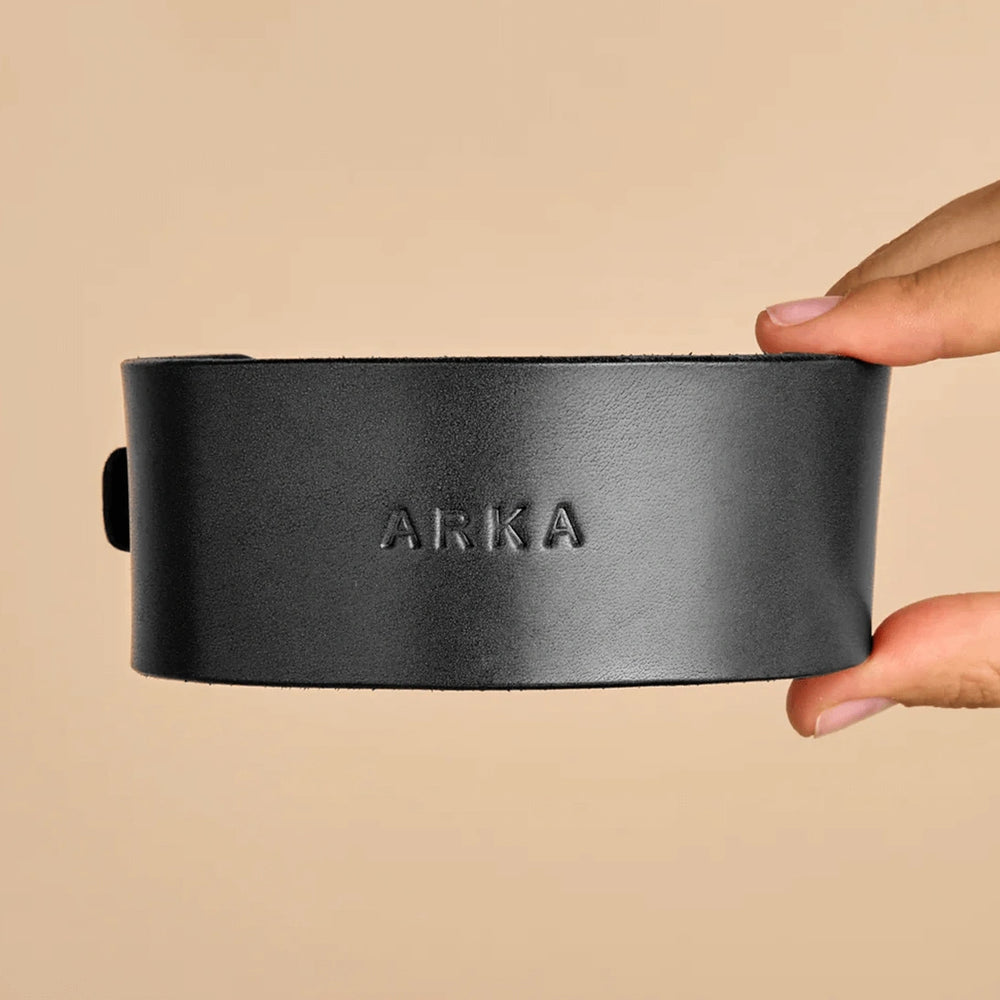
The most considered approach for Greyhound, Whippet, and sighthound owners is to use both tools for different purposes. A wide flat leather collar worn at all times for ID tag attachment gives your dog complete identification security without any entanglement risk. A martingale collar sourced from a specialist sighthound collar supplier handles supervised walks where the escape-prevention mechanism is needed most. The Lille Björn's wide vegetable-tanned leather collars are specifically designed for sighthound neck proportions: the 4.5 cm width distributes pressure evenly across the fat-free sighthound neck and the solid brass hardware provides the durability these active breeds demand for daily wear.

Proper Fitting Tips for Leather Collars
Once you get around to finding the wide leather collar that you think will work best for you and your pup, it is crucial to make sure that you get the fit completely right. Let us make it easier for you with these handy tips.
Measure Accurately
Wrap a soft flexible tape measure snugly around the middle of your dog's neck where the collar will naturally sit with no extra space left in the tape. Record that number. For The Lille Björn collars, that measurement is your collar size directly. Find the size range it falls within on our size chart and check that your measurement sits low enough within the range to leave room for two flat fingers before the upper limit. See our complete dog collar measuring guide for the full protocol.
Two Finger Rule
Once the collar you have selected is on, you can ascertain whether or not you have the right fit by doing the two finger check. If you can comfortably but snuggly fit two of your fingers between the collar and your pup’s neck, then that is tight enough to stay secure without risking restricting any airflow.
Check Regularly
As dogs grow, their proportions and weight can fluctuate (just like us!), so to keep on top of any changes it is important to get into the habit of regularly checking the fit of a collar. You can then adjust as needed to accommodate any changes, from size to fur thickness and everything in between!
Avoid Overloading
Try to avoid attaching too much unnecessary stuff to a collar, because it can add more weight and create distraction for your pup. Just a single ID tag should be enough to do the job you need, along with a good quality, sturdy leash attachment point for walk times.
Inspect for Wear and Tear
Make sure to regularly check for signs of any major wear and tear on your collar, like fraying edges of cracks in the leather. As soon as you think that the collar has reached the point of no return, then it is time to replace it. Thankfully, with something like vegetable tanned leather, this isn’t an issue that you are going to encounter very often!

Martingale Collar Sizing by Breed
For Sighthound Breeds
The control loop of a martingale must be sized so the collar closes to a comfortable snug not so tight it compresses, not so loose it can still slip over the head. For sighthounds, the fitting check is: when the control loop is fully tightened, you should be able to fit one flat finger between the collar and the neck, no more, no less. This is tighter than the standard two-finger rule for flat collars, because the function of the martingale is specifically to prevent a sighthound's narrower head from slipping through.
Are Martingale Collars Safe for Small Dogs?
Yes, a martingale collar sized correctly is safe for small dogs. The same principle applies regardless of breed: the control loop must be sized so the collar tightens to a snug fit at its maximum, not to a compressive one. For small breeds, choose a lightweight martingale with proportionally slim hardware so the collar's weight is not disproportionate to the dog's frame. Avoid wide martingales designed for large sighthounds on a small breed, the control loop mechanics are the same, but the proportions matter for comfort.
Are Martingale Collars Safe for Puppies?
Yes, with the same use boundaries that apply to adult dogs. A martingale is a supervised walking collar, put it on for walks, remove it when the puppy is unsupervised, in their crate, or at rest. For puppies, check the control loop sizing more frequently than for adults: puppies grow rapidly and a martingale that closes correctly at eight weeks may be fitting incorrectly by twelve. Check the fitting at least every two weeks during the first six months. A correctly fitted puppy martingale should close to a snug fit, you should be able to fit one flat finger at maximum closure and return to a relaxed loose fit when tension releases.
Frequently Asked Questions: Martingale Collar Safety
Are martingale collars safe?
Yes, martingale collars are safe when used correctly. They are designed with a preset maximum tightening limit: the control loop closes to a defined point that snugs the collar around the neck without compressing the trachea, then releases completely when tension drops. The safety rule is context-specific: martingales are walking collars used under supervision with a lead attached. They should not be worn unsupervised due to the control loop's entanglement risk. Within this boundary they are a safe, humane, and genuinely useful tool for the right breeds.
Are martingale collars cruel?
No. A correctly fitted martingale does not deliver pain, it delivers a gentle snugging sensation that signals to the dog that backing up or pulling is causing the collar to close. The release is immediate when tension drops. This is fundamentally different from choke chains or prong collars, which apply pain-based corrections with no preset limit. Major animal welfare organisations and sighthound rescue groups recommend martingales specifically as a humane, escape-preventing alternative to standard flat collars for breeds with narrow heads.
What is the difference between a martingale collar and a choke collar?
A martingale collar has a preset maximum tightening point built into its sizing when correctly fitted, it can close only to a snug fit around the neck, not beyond. A choke chain has no maximum limit and continues to tighten for as long as the dog pulls, creating genuine choking and tracheal compression risk. The martingale's controlled closure is what makes it humane; the choke chain's unlimited compression is what makes it dangerous. They are not equivalent tools.
Can martingale collars cause tracheal collapse?
A correctly fitted martingale collar is generally considered safer than a choke chain because it has a limited-slip design that prevents indefinite tightening, but it still applies some neck pressure and should be used cautiously in dogs with airway problems. For dogs with pre-existing tracheal sensitivity, consult your vet but the martingale's controlled mechanism makes it significantly safer than any tightening collar without a stopping mechanism.
Can dogs wear martingale collars all the time?
No, martingales should not be worn unsupervised. The control loop can catch on crate bars, furniture, fencing, and other objects when the dog is moving freely without a lead attached. The correct use boundary is: martingale on for supervised walks with a lead; flat collar or no collar for all unsupervised time including crates, gardens, and rest. For sighthound owners, a flat collar worn for ID at all times paired with a martingale used for walks is the most practical and safe approach.
Are martingale collars good for dogs that pull?
Martingale collars provide gentle feedback when a dog pulls, the collar closes, creating a clear sensation that the dog quickly learns to respond to but they are not primarily a pulling-management tool. They are an escape-prevention tool. For dogs that pull consistently, a well-fitted back-clip harness is the recommended approach for walk training. The martingale is the correct collar for walks on sighthound breeds regardless of pulling behaviour, because the escape prevention it provides is non-negotiable for those breeds. For pulling specifically, use the harness alongside the martingale.
Are martingale collars safe for puppies?
Yes, with the same boundaries that apply to adult dogs. Put the martingale on for supervised walks and remove it when the puppy is unsupervised, in their crate, or at rest. Check the control loop fit every two weeks: puppies grow rapidly and a correctly fitting martingale at eight weeks may be too small by twelve. At maximum closure you should be able to fit one flat finger between the collar and the neck; any tighter and the collar needs to be replaced with the next size up.
Conclusion
Martingale collars are not the safety concern they are sometimes made out to be. Used correctly as a supervised walking collar with a preset maximum that prevents both escape and choking they are one of the most thoughtfully designed collar types available. For Greyhounds, Whippets, Salukis, and any sighthound breed, they are not simply a good option. They are the correct one.
For sighthound owners, the complete setup is straightforward: a wide flat leather collar worn at all times for identification and everyday comfort, paired with a martingale collar from a sighthound specialist for supervised walks where escape prevention is critical. The two serve different roles and neither replaces the other. The Lille Björn's wide vegetable-tanned leather collars are built precisely for the sighthound neck, 4.5 cm width, soft full-grain leather, solid brass hardware, and a profile designed to sit comfortably on a neck with almost no fat padding.